How to Make Better Business Decisions Using Data-Driven Decision Making?

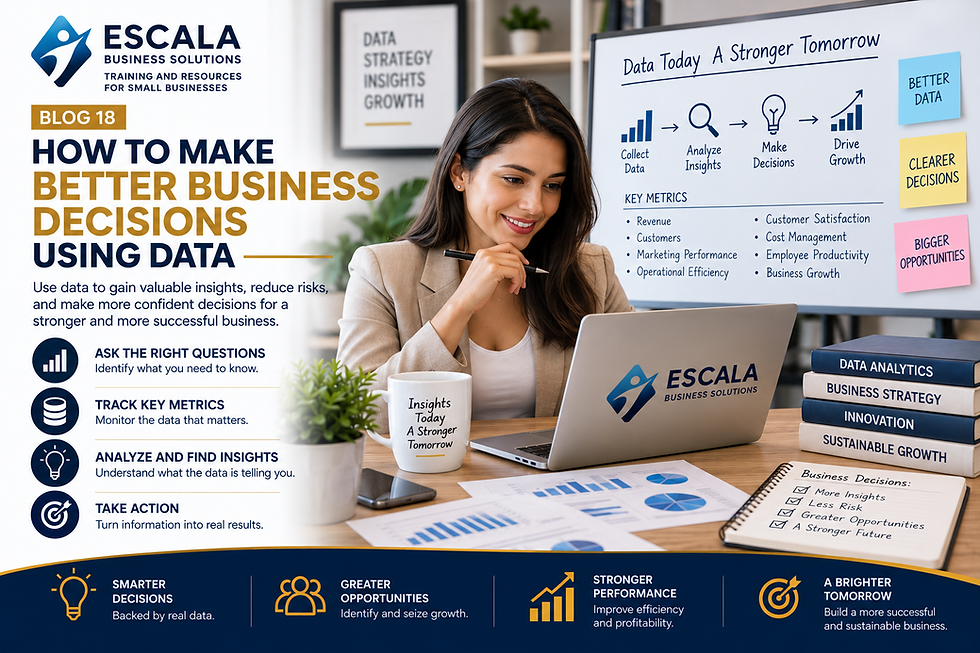
Business owners make decisions every day. Should you hire another employee? Which service should you promote? Are your expenses increasing too quickly? Which customers generate the most value?
While experience and intuition are valuable, reliable business data can provide additional information to support better decisions. Data-driven decision making allows organizations to use relevant information, trends, and performance indicators to make more informed choices.
What Is Data-Driven Decision Making?
Data-driven decision making means using accurate and relevant information to evaluate options and guide business decisions.
Business data can come from many sources, including:
Sales reports
Customer feedback
Website analytics
Financial statements
Marketing performance
Employee productivity
Customer service records
Operational reports
The goal isn't to collect as much data as possible. It's to identify the information that can actually help you make better decisions.
1. Start With the Right Questions
Before collecting data, determine what you need to understand.
For example:
Instead of:"How is the business doing?"
Ask:
Which services generate the most revenue?
Which marketing channels produce the most leads?
Where are operating costs increasing?
How long does it take to complete certain processes?
Which customers return most frequently?
Specific questions make data more useful.
2. Track Key Performance Indicators
Key performance indicators, or KPIs, help businesses measure progress toward important goals.
Depending on your organization, useful KPIs may include:
Revenue
Profit margin
Customer retention
Lead conversion rate
Customer acquisition cost
Employee productivity
Project completion time
Customer satisfaction
Choose KPIs that directly relate to your business objectives.
3. Organize Your Information
Data becomes difficult to use when it's scattered across different systems.
If sales information is in one spreadsheet, customer information is in another, and financial information is somewhere else, getting a complete picture can take considerable time.
Organizing information into centralized systems can make reporting and analysis easier.
4. Use Data to Understand Your Customers
Customer data can reveal valuable patterns.
You may discover:
Which products or services are most popular
When customers typically purchase
Which marketing channels generate inquiries
Why customers leave
What customers value most
These insights can help businesses improve marketing, customer service, and product or service offerings.
5. Monitor Financial Performance
Financial data is essential for making informed business decisions.
Regularly review:
Revenue
Expenses
Cash flow
Profitability
Accounts receivable
Operating costs
Understanding these numbers can help business owners identify financial trends before they become major problems.
6. Use Data to Improve Operations
Data can also reveal where internal processes need improvement.
For example, if a particular process consistently takes twice as long as expected, it may indicate a workflow problem.
Tracking performance over time can help organizations identify bottlenecks and determine where process improvements may have the greatest impact.
7. Turn Information Into Action
Collecting data isn't enough.
The most important step is using what you learn to make decisions.
For example:
Data: A marketing campaign generates many website visitors but very few inquiries.
Possible action: Review the landing page, messaging, offer, and call to action.
Data: A particular service generates strong revenue but requires significant administrative time.
Possible action: Review the process and determine whether technology or workflow improvements could increase efficiency.
Data becomes valuable when it leads to meaningful action.
Avoid Making Decisions Based on Bad Data
Poor-quality information can lead to poor decisions.
Before relying on data, consider whether it is:
Accurate
Current
Complete
Relevant
Consistently collected
Businesses should also avoid focusing on a single metric without considering the larger picture.
Benefits of Data-Driven Decision Making
Using data effectively can help businesses:
Make more informed decisions
Identify opportunities
Reduce unnecessary risks
Understand customers
Improve operations
Monitor financial performance
Measure progress
Plan for future growth
Data doesn't replace experience or judgment. It gives leaders better information to use alongside them.
How ESCALA Business Solutions Can Help
At ESCALA Business Solutions, we help businesses and organizations use information more effectively to support planning, operational improvement, and strategic decision making.
Our consulting approach focuses on turning business information into practical insights and actionable strategies.
Whether you're trying to improve operations, understand performance, or prepare your organization for growth, ESCALA can help you identify the information that matters most.
Final Thoughts
Data-driven decision making gives business owners a clearer picture of what's happening inside their organization.
By asking the right questions, tracking meaningful KPIs, organizing information, and turning insights into action, businesses can make more confident decisions and respond more effectively to changing conditions.
The goal isn't simply to have more data. It's to use the right data to make better decisions.
Ready to make more informed decisions about your business? Contact ESCALA Business Solutions to learn how strategic consulting and practical solutions can help your organization move forward.
Image Alt Text: Business professionals analyzing business data, charts, KPIs, and performance reports to make strategic decisions.


Comments